Sponsored article
How Do Mould Design and Maintenance Affect the Cost-Effectiveness of an Entire Production Run?
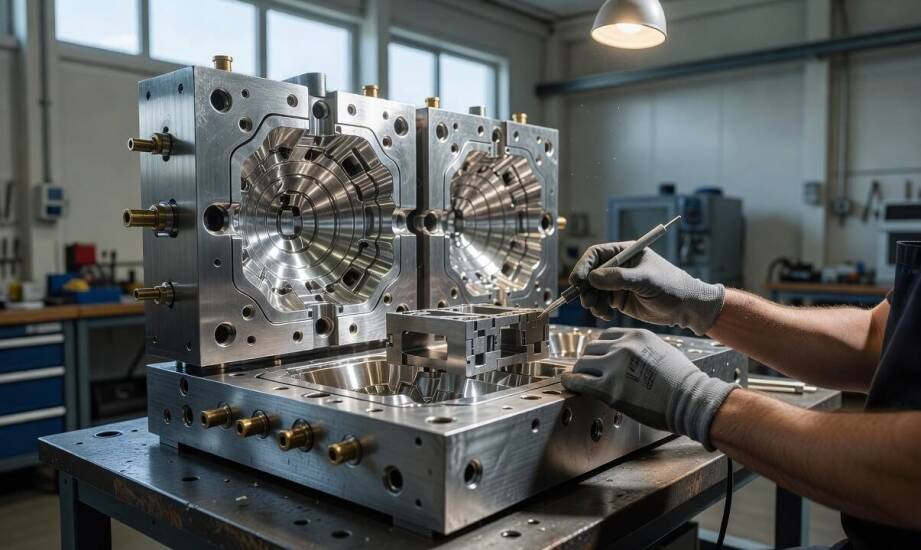
- How Do Design Decisions Influence Future Maintenance Costs?
- How Do Tool Requirements Change During Different Production Stages?
- How Can Modular Mould Design Reduce Downtime?
- How Do the Polymer and Part Geometry Affect Mould Wear?
- Why Is Cooling-System Maintenance Important?
- Why Does Integration Between the Tool Room and Injection-Moulding Department Matter?
- How Does Maintenance Affect the Total Cost of Ownership?
- When Is Mould Repair Economically Justified?
- When Is a New Injection Mould a Better Option?
- Design and Maintenance Should Be Considered Together
- FAQ
An injection mould is a production asset whose real cost should be assessed over its entire working life rather than only at the moment of purchase.
Read more: When to Decide on an Office Renovation?
Decisions made during tool design influence later cycle time, maintenance requirements, process stability, downtime and the quality of thousands or even millions of moulded parts.
For this reason, the cheapest tool at the purchasing stage is not necessarily the most economical solution over the complete production programme.
A realistic total-cost analysis should consider not only mould manufacturing but also how the tool will behave during continuous operation, how easily it can be maintained and whether its design matches the polymer, expected production volume and product geometry.
How Do Design Decisions Influence Future Maintenance Costs?
Tool-steel selection, cooling design and gate location are among the decisions that can have a long-term effect on mould economics.
The appropriate steel grade depends on factors such as:
expected tool life;
processed polymer;
abrasive fillers;
corrosion risk;
surface-finish requirements;
dimensional tolerances.
Aluminium or more easily machinable steels can be suitable for selected prototypes and short-run applications, while longer production programmes or abrasive compounds may justify tool steels with greater wear resistance.
There is no single steel that is optimal for every mould.
Cooling design is equally important.
Cooling channels determine how efficiently heat is removed from the part and mould after each shot. If thermal control is poorly balanced, the consequences may include longer cycle times, greater warpage and inconsistent dimensions.
Because cooling often accounts for a significant part of the total injection-moulding cycle, even relatively small improvements in thermal management can affect the cost per finished part over a long series.
Gate location also influences filling behaviour.
A poorly selected gate can contribute to long flow paths, visible weld lines, air traps or difficulties during packing. Correcting these limitations after the mould has already been manufactured can be considerably more difficult than analysing them during the design stage.
How Do Tool Requirements Change During Different Production Stages?
A mould does not have to meet exactly the same priorities during prototyping, process validation and long-term series production.
At the prototype stage, speed and flexibility may be particularly important.
Selected trial tools can be manufactured from aluminium or from more easily machinable pre-hardened steels. The objective is often to verify:
geometry;
assembly;
filling behaviour;
functionality.
Once the product enters the validation stage, attention shifts toward finding a stable processing window and correcting any remaining tooling limitations.
For established series production, priorities increasingly include:
dimensional repeatability;
stable cycle time;
reliable cooling;
predictable ejection;
resistance to wear.
During long-term operation, maintenance becomes more important as well. Cooling channels, guiding elements, moving mechanisms, shut-off surfaces and cavity inserts should all remain in a condition that supports repeatable production.
How Can Modular Mould Design Reduce Downtime?
Serviceability should ideally be considered while the mould is still being designed.
Areas exposed to predictable wear can sometimes be manufactured as replaceable inserts rather than as permanent parts of a large cavity block.
The same principle can be applied to selected:
slides;
cores;
guide elements;
ejector components.
When a replaceable component becomes worn, it may be possible to repair or replace only the affected element rather than reworking a much larger part of the mould.
Standard mould components can also simplify spare-parts sourcing and maintenance.
This does not mean that every repair can be completed within a few hours or without removing the mould from the machine.
Service time still depends on the construction of the tool and the extent of the damage.
However, designing critical wear components with maintenance in mind can significantly reduce the complexity of future repairs.
How Do the Polymer and Part Geometry Affect Mould Wear?
The rate of mould wear depends strongly on the material being processed.
Polymers containing hard fillers such as glass fibres or certain mineral additives can be considerably more abrasive than unfilled thermoplastics.
Repeated flow of such compounds through runners, gates and cavities may increase wear in areas exposed to high velocity and pressure.
Particularly sensitive areas can include:
gates;
cavity edges;
slides;
shut-off surfaces;
inserts.
In these applications, steel selection, surface treatment and replaceable wear components can become economically important.
The geometry of the moulded component also affects the tool.
Thin sections and long flow paths can require demanding filling conditions. Undercuts may require slides, lifters or other moving mechanisms, introducing additional contact surfaces that require lubrication, inspection and eventual replacement.
It would be too simplistic, however, to say that every thin-walled part automatically requires higher mould temperatures or higher holding pressure.
The required settings depend on the polymer, flow length, wall thickness, gate design and injection strategy.
Why Is Cooling-System Maintenance Important?
Cooling performance can gradually change during the life of a mould.
Deposits, corrosion or restrictions inside cooling channels can reduce heat transfer and change the thermal balance that was established during process validation.
This can lead to:
longer cycle times;
different shrinkage behaviour;
dimensional drift;
increased warpage.
For this reason, cooling circuits should be considered part of the mould-maintenance strategy rather than as a system that requires attention only after a serious problem appears.
A well-maintained cooling system helps preserve the process conditions on which the original cycle and quality parameters were based.
Why Does Integration Between the Tool Room and Injection-Moulding Department Matter?
When product engineering, mould manufacture and injection trials are coordinated within the same organisation, feedback from production can reach the toolmaking team more directly.
If a trial reveals a problem related to:
gate geometry;
cooling;
ejection;
an insert;
a dimensional feature,
engineers can analyse whether the best solution is a process adjustment or a physical tooling modification.
Noex combines engineering, CNC machining, mould manufacture and injection moulding within its production environment.
Its tool room manufactures trial and multi-series moulds, including cold- and hot-runner, single- and multi-component and slider-type designs.
When specifying an injection mould for plastic, this type of integration can help connect tooling decisions with the conditions that will later be encountered during actual production.
The main benefit is a shorter feedback path between design, machining and mould trials.
How Does Maintenance Affect the Total Cost of Ownership?
The initial price of the tool is only one element of production economics.
Over its service life, the mould can also generate costs associated with:
maintenance, spare parts, process interruptions, longer cycle times, quality losses and unplanned downtime.
A slightly more expensive mould may therefore prove more economical when its design reduces these later costs.
Conversely, over-specifying a tool for a very short production run can make the project unnecessarily expensive.
This is why mould design should reflect the real production programme rather than pursue maximum durability without considering how many parts will actually be manufactured.
When Is Mould Repair Economically Justified?
Repair or refurbishment may be reasonable when wear is localised and the fundamental structure of the mould remains suitable for continued production.
Typical candidates for repair can include damaged or worn:
inserts;
cavity surfaces;
guide elements;
selected moving components.
The decision should be based on more than the immediate repair price.
Engineers should also consider:
remaining planned production volume;
overall condition of the mould;
expected repair life;
future maintenance risk;
required downtime;
availability of spare parts;
whether the product design is likely to change.
A local repair can be considerably less expensive than building a complete new tool, but this is not always the case.
If the mould has widespread wear, serious structural damage, obsolete components or major cooling problems, repeated repair may no longer be economically justified.
When Is a New Injection Mould a Better Option?
A new tool may become the better investment when:
the existing mould can no longer maintain the required dimensions, its basic geometry needs significant modification, production demand has changed substantially or the original construction no longer provides sufficient capacity.
A growing production volume can also justify a redesign.
For example, increasing cavity count or changing the runner concept may reduce the manufacturing cost per part.
However, a hot-runner system or higher-cavity mould is not automatically the correct solution simply because demand has increased.
The economic calculation should include:
expected production volume;
cycle time;
material consumption;
runner waste;
machine requirements;
mould investment;
maintenance.
The objective is always to minimise total cost per acceptable part throughout the expected production life.
Design and Maintenance Should Be Considered Together
A production mould should not be treated as a static piece of steel that is purchased once and then used until it fails.
Its long-term economics depend on the interaction between design, processed material, production volume and maintenance.
Correct steel selection can reduce wear.
Balanced cooling can support shorter and more repeatable cycles.
Replaceable components can simplify certain repairs.
Preventive maintenance can help preserve the process conditions established during validation.
At the same time, unnecessary complexity increases initial investment without necessarily producing a return.
The most economical mould is therefore not always the cheapest or the most technically advanced one.
It is the tool whose construction, durability and maintenance strategy are matched to the real requirements of the production programme.
This approach helps control downtime, maintain dimensional repeatability and manage tooling costs throughout the service life of the project.
FAQ
When does an injection mould wear fastest?
Wear generally increases when abrasive compounds such as glass-fibre-reinforced plastics or materials containing hard mineral fillers are processed. Gates, cavity surfaces, slides and shut-off areas can be particularly exposed. The actual wear rate also depends on production volume, mould steel and processing conditions.
Which mould components are worth designing as replaceable?
Replaceable cavity inserts, cores and selected wear components can be useful in areas expected to require future maintenance. Standardised guide and ejection components can also simplify servicing. The best approach depends on the mould design and expected wear pattern.
How does cooling influence the cost of series production?
Cooling affects both cycle time and dimensional stability. Inefficient or unbalanced cooling can extend production cycles and increase warpage or variation between parts. Over a large production volume, even a relatively small increase in cycle time can have a noticeable economic effect.
When is mould refurbishment preferable to building a new tool?
Refurbishment can be economical when wear is localised, the mould structure remains sound and the tool still matches future production requirements. The decision should also include the remaining production volume, repair life and expected downtime.
When should a completely new mould be considered?
A new tool may be preferable when the existing mould has extensive wear or structural damage, requires major product-geometry changes or no longer provides sufficient production capacity. The decision should be based on total future cost rather than repair price alone.
You might be interested
Why Microencapsulation and Spray Drying Improve Flavour Stability in Dry Products

How to properly use car cleaning products?

When to Decide on an Office Renovation?
